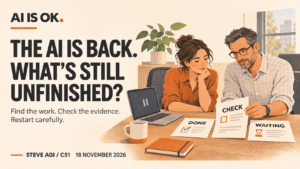
Forget the AI Hype. What Can Your Team Use This Week?

Last week we asked whether your AI test made the work better, or simply made one number look better. Count the checking, corrections and handoffs before declaring victory.
Suppose the answer is promising. What happens on Monday when the person who ran the test is busy, the instructions are in their chat history and everyone else has actual work to do?
That is where a useful experiment can quietly become another abandoned subscription.
The next step is to make one useful practice repeatable by the people doing the work. Forget the grand prediction about what AI might do one day. Ask what your team can use this week, who owns it and how you will know it helped.
1. Start with the colleague, not another tool
If you have already chosen a recurring problem, stay with it. You do not need a fresh use case because a new model appeared on Tuesday.
Sit with the person who actually does the job. Ask them to walk through the last real example, including the missing information, the checking and the bit nobody mentions in the procedure.
Where does their judgement matter? What do they keep correcting? What would make the next handoff easier?
Involve them in choosing the test and the measure. A manager announcing that AI will save someone hours is a prediction. The colleague explaining what still needs fixing is evidence about the work.
If you work alone, look at the person receiving your output. A client or supplier may see a problem your own completion counter misses.
2. Give AI a small job with a clear finish
Here is a fictional example. A small team prepares a weekly marketing update from an approved campaign report. The time-consuming part is turning the same figures and notes into a readable first draft.
The bounded task could be: draft five bullets using only the supplied report, separate observed results from possible explanations, and list anything missing. Do not invent figures, make spending recommendations or publish anything.
The colleague checks each claim against the report. The campaign owner decides what it means and what to do next. Anything unclear goes back to that owner.
That is a useful division of work. It gives AI something specific to attempt and leaves commercial judgement with a person who understands the campaign.
If the real delay is waiting for the report, a better prompt will not make the source arrive. Fix the handoff first. You may not need AI for that part at all.
3. Write the handoff so someone else can use it
A clever prompt in one person’s private chat is a fragile operating procedure.
Keep a short instruction beside the task, in a place the team is already authorised to use:
- Input: the approved source and the version or reporting period.
- AI task: exactly what it may draft, extract or organise.
- Human check: what must be compared with the source before use.
- Owner: the person who approves the result and the next action.
- Exception: what stops the task and who handles the problem.
For our marketing example, an unsupported figure or missing report stops the draft from going out. The owner resolves it; AI does not fill the gap with something plausible.
Use tools and information your business has approved for the purpose. A tidy instruction does not authorise uploading customer records, confidential finances or staff information somewhere new.
Now ask the colleague to explain the instruction back in their own words. If they need you standing beside them to interpret it, there is still work to do.
4. Build a short learning rhythm into the job
A training day can provide a useful introduction. It cannot settle every question that appears when someone tries the tool on real work.
Try a ten-minute weekly review attached to the existing task. Bring one example that helped, one correction and one question. No slide deck required.
What did we ask it to do? What came back? What did we have to fix? What will we change next time?
Keep the useful instruction and the important failure in a short shared note. Improve one thing at a time. Next week, use the same task to see whether that change helped.
You are building a team memory that survives a closed browser tab. It should also make it easier for someone to say, without embarrassment, that the result was wrong or the tool was more trouble than it was worth.
That honesty matters more than getting everyone to say they are excited about AI.
5. Keep what earns its place
Return to last week’s whole-task review. Include preparation, checking, corrections and the work passed to the next person. Keep quality and exceptions visible alongside time.
If the change helps on comparable work, document it and test whether another authorised colleague can follow the same process. A successful handoff is useful evidence of repeatability, not permission for a company-wide rollout.
If the result is mixed, narrow the task. If it adds work or creates unacceptable mistakes, stop. Keep the lesson without keeping the subscription out of pride.
The business does not owe a tool a permanent job because the demo was impressive.
Your next action: book the second use
Take the promising test you reviewed last week and complete this sentence with the colleague involved:
This week, [person] will use AI for [bounded task] with [approved input]. [Reviewer] will check [specific things]. If [stop condition] happens, we will [fallback]. We will review the whole task on [date].
Book that review now. Then run the task again. Keep a note of one useful result and one correction.
The first attempt shows what might be possible. The second, with a clear owner and a usable handoff, starts to show whether it belongs in your business.
Where would you start: one marketing update, one finance preparation task, or one recurring job your team already wishes would go away?
Give the habit somewhere practical to start
The AI is OK Working Playbook is A$10/month self-service access to the original 21-page Systems That Work PDF, an editable workbook and the interactive Find the Problem exercise. Define one problem, build a small test and review the result at your own pace.
Download your project file and reopen it to continue. Progress stays in your file, not in your member account. Selected resources are added when useful and ready. Consulting and individual implementation are separately scoped. Recurring monthly access; cancel any time.
Explore the A$10/month Working Playbook
The weekly newsletter stays free. Subscribe by email or read past issues, with no LinkedIn account required.
Start small. Keep people accountable. Check what actually changed.
Until next time, stay curious, stay scrappy, and remember: AI is OK.
Steve AGI / C51
Previous editions and references
- Your AI Test Looks Better. Is the Work Actually Better?, 28 October 2026.
- Your AI Can Count Clicks. It Still Can’t Manage People., 26 October 2026.
- Finding a Middle Ground on Data Centres and Waste Heat, 26 October 2026.