The AI Is Back. What Is Still Unfinished?
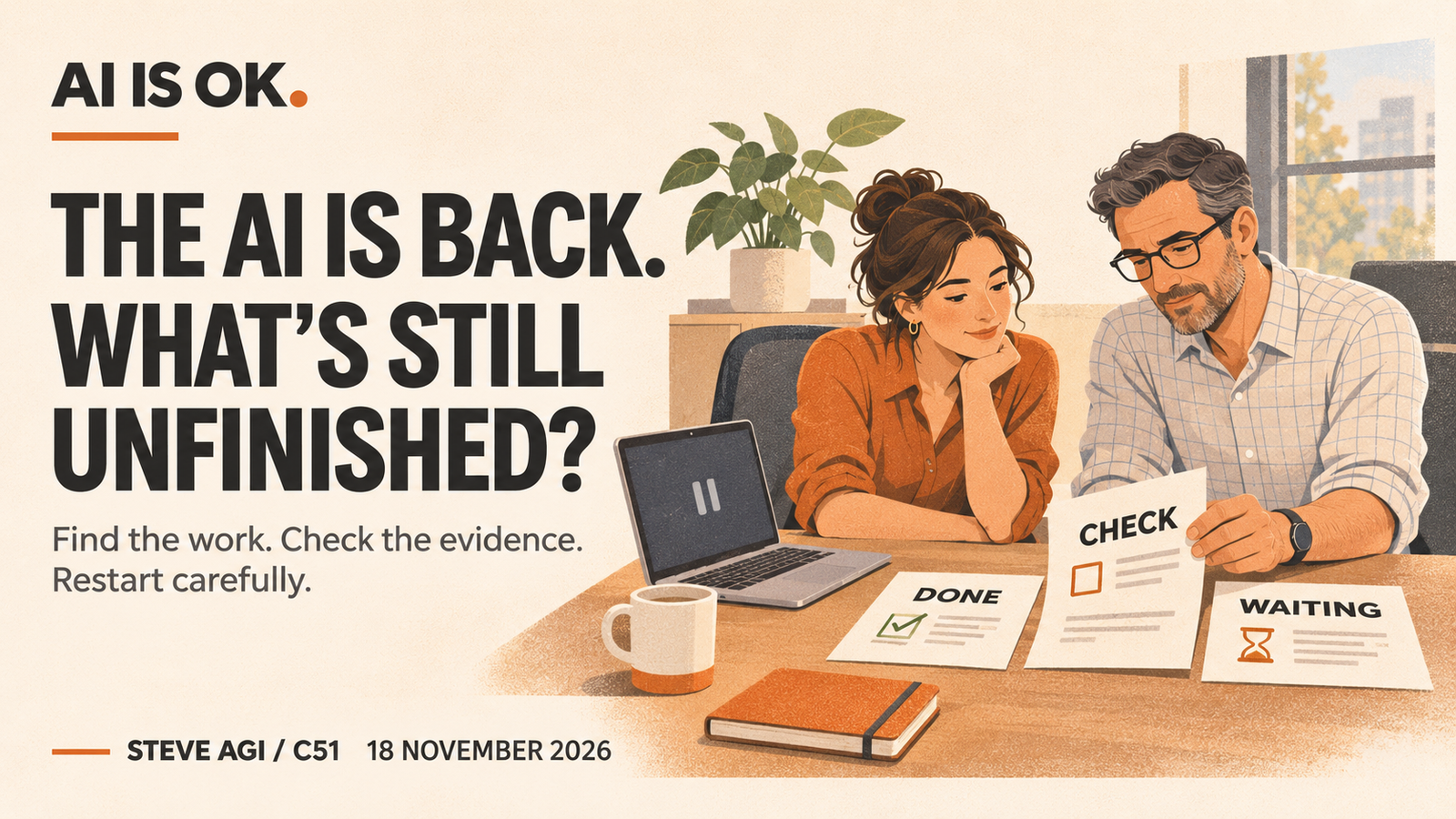
Last week we asked what your AI trial had earned permission to do next. On Monday, we looked at another limit: the supplier can change the rules, or disappear from your working day altogether.
There is one more awkward moment worth rehearsing. The service comes back. Someone says, “Great, just run it again.”
Hang on. What finished before it stopped? What did someone complete manually? Which customer is still waiting? A working connection does not answer any of those questions.
This week, take one useful workflow and practise recovering the work. Keep it small. You are looking for the next unfinished commitment, the evidence of its status and the person who can move it.
1. Find the work without opening the missing tool
A fallback instruction is little use if it sits inside the service you cannot reach. The same goes for a queue of outstanding jobs that only that service can display.
Choose an authorised place your team can reach independently of the failed service. Keep only the information needed to continue: a job reference, its owner, the next agreed action, the deadline and where to find the approved source. Keep access limited to the people who need it.
Do not make a casual copy of every customer file in the name of resilience. A small continuity record should follow your existing access and retention rules. If it shares the same unavailable login or storage, it may not solve the problem. Test that assumption.
2. Separate completed, waiting and unknown
Here is a fictional example. A business uses AI to draft quote summaries from approved job notes. A person checks the details and sends the quote through the normal quoting system.
The drafting service stops halfway through the morning. One quote was sent and has a recorded reference. Another has a draft but no approval. A third appears to have started, but nobody can establish its status.
Those are three different jobs. Mark the first completed, leave the second waiting for its reviewer, and mark the third unknown until someone checks the source records. Do not treat the whole batch as failed and start again.
A generated draft is evidence of a draft. A sent record is evidence of a send. Neither, by itself, proves the customer received, accepted or acted on it. Use the evidence appropriate to the next decision.
3. Give exceptions an owner and a next check
“We are looking into it” can keep a job suspended for days. For each unresolved item, name one person responsible for finding out what happened, the next source they will check and when they will report back.
That person may need the reviewer, supplier or customer to clarify something. They still own the follow-through. Keep the question visible instead of letting several people assume somebody else is handling it.
When the evidence remains uncertain, pause the consequential action. Do not resend a quote, repeat an account update or make another commitment simply because the software offers a retry button. Establish the existing result first.
4. Restart one checked item before the queue
When the service returns, compare its queue with the work completed during the interruption. Record which items need no further action, which can resume and which still need a decision.
Choose one ordinary item that is safe to resume under your existing approvals. Check the source, the output and the record of what happened. If the result is wrong or unclear, stop and resolve it before releasing the remaining work.
Keep the same human checks that made the original trial useful. An outage is not a reason to widen permissions, skip approval or move confidential information into an unapproved replacement tool.
5. Decide whether the extension still earns its place
Back at the expansion brief, add the time spent finding work, resolving uncertainty and restarting. Include the effort of keeping the fallback usable. Ask the colleague receiving the output what became harder.
You may keep the extension, narrow it or return to the earlier process. Perhaps the drafting still helps, while the automatic handoff needs work. That is a useful decision. You do not have to keep every connection to justify the subscription.
The point is to improve the whole job. A workflow that saves ten minutes on a normal day but leaves nobody able to explain its unfinished work needs attention before it takes on more responsibility.
Your next action: rehearse three unfinished jobs
Use made-up or suitably de-identified examples in a walkthrough. Do not disconnect a live system or interfere with customer work. Pick one completed item, one waiting for approval and one with an uncertain result.
For each, write five short notes: the job reference; the evidence of its current state; the next authorised action; the person responsible; and the next check time. Ask a colleague to find those notes without using the service you are pretending is unavailable.
Can they tell what to leave alone, what to continue and what to investigate? If they need your private chat history to answer, fix that gap before adding another integration.
You now have something concrete to bring to your next weekly review: one recovery gap, one owner and one change to test. The next useful question is whether that change survives an ordinary week without creating another maintenance job nobody owns.
Put one problem into a working brief
The AI is OK Working Playbook is A$10/month self-service access to the original 21-page Systems That Work PDF, an editable workbook and the interactive Find the Problem exercise. Define one problem, build a small test and review the result at your own pace.
Download your project file and reopen it to continue. Progress stays in your file, not in your member account. Selected resources are added when useful and ready. Consulting and individual implementation are separately scoped. Recurring monthly access; cancel any time.
Explore the A$10/month Working Playbook
The weekly newsletter stays free. Subscribe by email or read past issues, with no LinkedIn account required.
Keep the useful shortcut. Keep sight of the unfinished work.
Until next time, stay curious, stay scrappy, and remember: AI is OK.
Steve AGI / C51
Previous editions
- Your AI Workflow Is Rented. What Happens When the Supplier Changes the Rules?, 16 November 2026.
- Your AI Trial Worked. What Gets Permission to Grow?, 11 November 2026.
- Forget the AI Hype. What Can Your Team Use This Week?, 4 November 2026.